
Can a Dead Tree Have Green Leaves
Table Of Contents
- Introduction
- Understanding How Trees Live and Die
- How Can a Dead Tree Still Have Green Leaves?
- Why Does This Matter for Tree Care?
- Possible Indications that a Tree is Dead Despite Green Leaves
- The Role of an Arborist Report
- Conclusion
Can a Dead Tree Have Green Leaves?
Trees with green leaves are considered more commonly alive. Thus, when you see a tree that appears green and healthy with its leaves, it is natural to believe that the tree is not dead. Nevertheless, things are not always what they seem. At times, it happens that there is a situation where a tree has green leaves but is dying on the inside. This poses an interesting and essential question to homeowners, gardeners, and landscapers in New Zealand.
Can dead trees have green leaves? The answer isn’t as straightforward as you might think, and understanding it is essential for proper tree care, preventing hazards, and maintaining the health of your garden or property.
In this comprehensive guide, we’ll explore how this phenomenon occurs, the biological processes behind it, how to tell if your tree is truly dead, and when to consider an arborist report or dead tree removal.
Understanding How Trees Live and Die
Before we understand how a dead tree could bear green leaves, it is pertinent to be aware of how trees operate.
Trees are highly complex in their survival. The best parts to survive consist of:
- Roots take up water and minerals in the soil.
- Branches and trunks transport water and minerals to all parts.
- Leaves make food with the help of photosynthesis.
- The cambium layer is the living tissue just under the bark that produces new cells.
One or more of these systems may fail when a tree is damaged as a result of a disease, pests, drought, or injury. A tree can be said to be biologically dead at the point when the supply of new cells to it by the peel layer ceases, and the roots fail to provide it with water to the upper parts.
Nevertheless, such a shutdown is not always immediate. They leave certain parts of the tree intact in the temporary belief that there can still be some functioning parts of the tree, which gives rise to some weird scenarios where we see a dying or dead tree that can still exhibit some life signs.
How Can a Dead Tree Still Have Green Leaves?
Although it will seem contradictory, a technically dead tree may carry green leaves in a few cases:
- Delayed Biological Response
In the event of gravely harming the roots of a tree, the tree can lose the capability of remaining alive in the long run. However, in case the destruction happens overnight (such as due to construction, flood, or lightning), the leaves can keep their green colour for weeks or months. This is because the leaves are already full of stored energy and moisture, which enables them to remain alive temporarily long after the tree is dead inside. - Partial Death or Compartmentalisation
In some cases, only a section of the tree dies, leaving other portions alive. Consider, e.g. infection by a fungus, insect infestation which kills the side of the tree, leaving the other side still in use. This may cause an odd combination of lush green foliage and totally dead branches on the same tree. - Sap Flow After Death
Sap and water may continue in the vascular system after death, in rare cases, for some time. This residual water can keep leaves alive temporarily, and the tree does not die even in conditions when its key processes have shut down. - Dormancy Confusion
New Zealand is one country many of whose native and exotic deciduous trees drop their leaves during a natural dormancy period in winter. A tree at an advanced stage of deterioration may leaf out in spring because it has some resources stored, even though it will never be able to withstand the next season.
Why Does This Matter for Tree Care?
The peculiar climate of New Zealand provides fairly wet winters, contrasted with dry summers and sometimes storms that give rise to numerous issues regarding the health of trees. Urban trees also experience more stress due to limited root space, compaction and pollution.
If you mistake a dying tree for a healthy one because it still has green leaves, you might delay essential tree care. This may create more safety risks, especially when the tree has already been physically impaired.
A dead or a dying tree may:
- Fall huge branches.
- Collapses when the winds are strong or when there are storms.
- Transmit the pests or disease to the healthy trees surrounding it.
That’s why early detection, even if the leaves still look healthy, is a vital part of tree care for property owners.
Possible Indications that a Tree is Dead Despite Green Leaves
It cannot be a guarantee that green leaves make up a healthy tree as such, look at the other signs listed below:
- Bark Condition
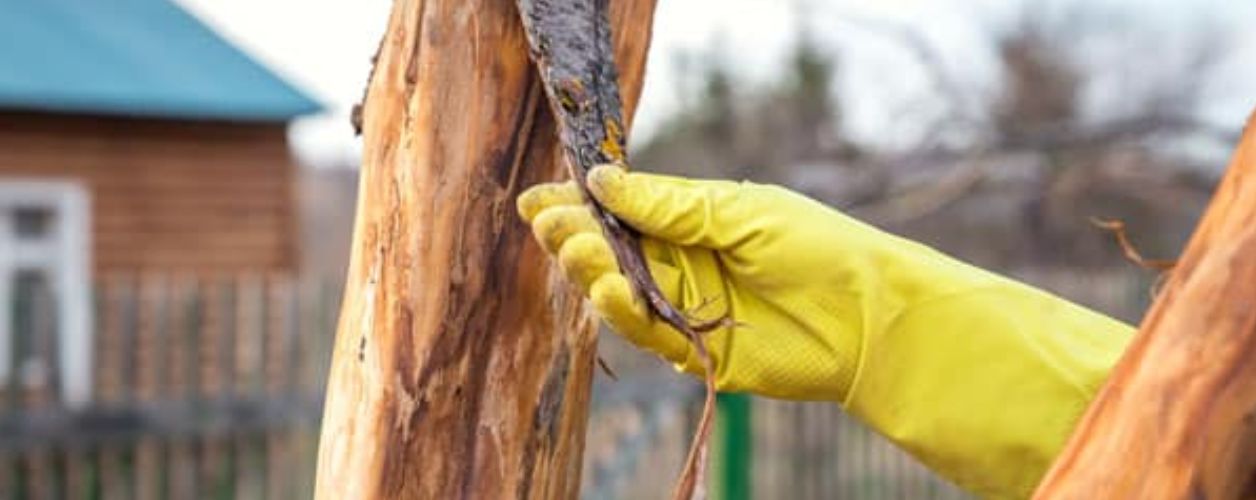
Power and healthy bark normally tend to be pliable and whole. Any peeling, cracking or loss of bark overall or on large parts of a tree can be a sign of death or pronounced deterioration. - Branch Flexibility
Bend a slender shoot. In case it breaks with little effort and is dry on the inside, then the corresponding section of the tree is dead. Fresh twigs are soft, and they possess a green colour beneath the surface. - Fungal Growth
Dead or dying mushrooms (mushrooms, bracket fungi, or conks growing on the trunk or the roots) usually indicate widespread decay within the tree. - Root Damage
As a symptom of distress, visible root damage by construction, flooding, or insects is a good indication of poor health. - Crown Dieback
When comparing the growth level on upper branches as well as the colour of leaves, a lack of growth or leaves as compared to the leaves and the growth on other lower branches may show a sign of decline that would eventually kill the tree once this condition ceases.
The Role of an Arborist Report
If you’re unsure whether your tree is dead, dying, or just stressed, the safest approach is to request an arborist report.
The duty of a New Zealand certified arborist will be:
- Check the health of the tree in general.
- Look at the pests, diseases and weak condition.
- Test soil conditions.
- Provide a written report with recommendations for treatment or dead tree removal if necessary.
Many local councils require an arborist report before you can remove certain trees, especially protected species. Not only does it assist you to come up with the informed decisions, but it also makes you compliant with regulations.
Conclusion
Seeing green leaves on a dead tree is not a surprise anymore. Under some conditions, such signs may lead to property owners being unaware of serious problems that need attention.
Visual checks with professional advice are the most effective solution. An arborist report will confirm the tree’s condition, and if necessary, timely dead tree removal will keep your property safe.
In New Zealand, where strong winds, storms, and unique environmental conditions can turn a weakened tree into a hazard, proactive tree care is essential. Waiting until green leaves turn brown on your tree is far too late; usually, the damage by that time is done. A timely inspection by an arborist or gardener can keep your tree in the best condition and help you get rid of dead branches or trees at the right time.
YOU MIGHT ALSO BE INTERESTED IN
Capital Cities
- Arborists Services in Whangarei
- Arborists Services in Auckland Central
- Arborists Services in Hamilton
- Arborists Services in Whakatane
- Arborists Services in Gisborne
- Arborists Services in Napier Terrace
- Arborists Services in Stratford
- Arborists Services in Palmerston North
- Arborists Services in Wellington Central
- Arborists Services in Richmond
- Arborists Services in Nelson East
- Arborists Services in Blenheim Central
- Arborists Services in Greymouth
- Arborists Services in Christchurch
- Arborists Services in Dunedin Central
- Arborists Services in Invercargill
- Arborists Services in Waitangi